Founded in 2006, Guoxin Glass has established a solid 20-year track record as an industry-leading manufacturer of high-performance architectural glass.
Over two decades of structural expansion and research focus, we have accumulated deep technical expertise in the manufacturing, processing, and application design of aluminum window frames, specialty fireproof barriers, custom structural laminated systems, and thermal-performance insulating glass panels. Our focus on engineering excellence and materials science enables us to deliver custom solutions that align with regional building regulations and high architectural demands globally.
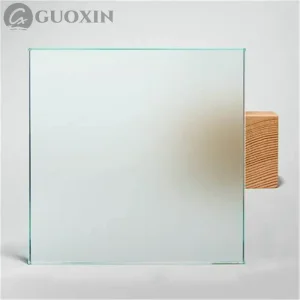
Custom frosted glass is a versatile architectural medium that balances light transmission with visual privacy. By altering the smooth surface of float glass, light rays are scattered in multiple directions, transforming transparent glass into a translucent panel. For high-end applications, selecting the appropriate manufacturing technique is critical to achieving the desired aesthetics, tactile quality, and maintenance profile.
Acid etching uses hydrofluoric acid to selectively dissolve the silica on the glass surface, creating a micro-rough texture. This process delivers an exceptionally uniform satin finish that is smooth to the touch. Acid-etched glass is highly resistant to grease, fingerprints, and smudging, making it the preferred choice for high-traffic interiors, glass doors, and balustrades.
Sandblasting uses high-pressure air streams mixed with abrasive media (like aluminum oxide or silica sand) to mechanically abrade the glass surface. This technique allows for highly customizable levels of opacity, shaded gradients, and intricate decorative patterns. The resulting surface is coarser than acid-etched glass and typically requires a protective coating to prevent oil and dirt adhesion.
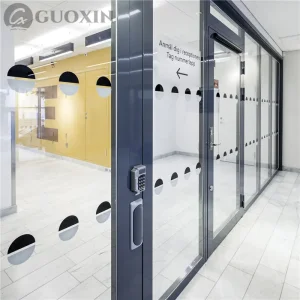
For large-scale exterior cladding, partition walls, and high-touch surface applications, acid-etched glass is generally preferred due to its chemical stability and ease of cleaning. For artistic signage, complex logos, and bespoke geometric designs where variable opacities are required, sandblasted glass provides the necessary mechanical control.
| Performance Indicator | Acid-Etched Glass | Sandblasted Glass | Applied Ceramic Frit (Frosted Effect) |
|---|---|---|---|
| Surface Roughness (Ra) | 0.5 µm - 1.5 µm (Highly Uniform) | 2.0 µm - 5.0 µm (Coarse/Textured) | N/A (Coated Layer) | Visible Light Transmission (VLT) | 75% - 88% (Depending on substrate thickness) | 65% - 82% (Depending on grit profile) | 40% - 70% (High opacity variation) |
| Fingerprint/Stain Resistance | Excellent (Hydrophobic surface chemistry) | Moderate (Requires protective sealer) | Good (Easy to clean vitreous enamel) |
| Structural Integrity | Maintains original mechanical strength | Micro-fractures may lower impact thresholds | Tempering stage bonds ceramic paint fully |
| Processing Options | Can be tempered, laminated, or insulated | Can be tempered post-processing | Must be processed during tempering cycle |
Modern commercial developments place complex demands on raw materials. Sourcing structural products like custom frosted glass requires balancing cost efficiency, long-term performance, and supply chain security. Commercial buyers, facade consultants, and architectural procurement specialists prioritize key criteria when auditing source manufacturers:
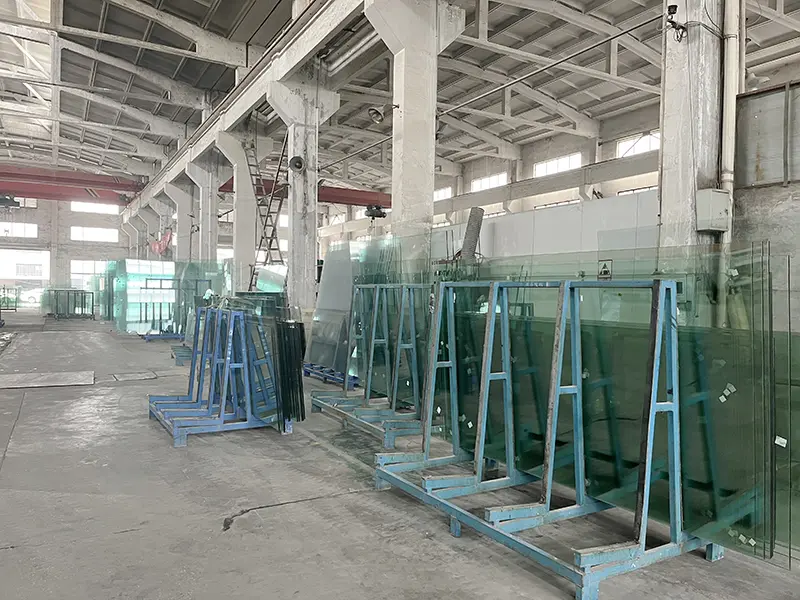
Industrial projects require hundreds of glass panels to match in color tone, visible light transmission percentage, and micro-texture. At Jiangsu Guoxin Glass, we run advanced automated processing lines that regulate temperatures and chemical contact times, ensuring minimal deviation across massive batch runs.
Procuring raw sheets is rarely sufficient. Global buyers require manufacturers capable of performing secondary tempering, heat soak testing, CNC edge polishing, precise hole drilling, and lamination using SentryGlas (SGP) or PVB interlayers to fulfill structural load-bearing and overhead safety requirements.
Transporting heavy glass panels across oceans demands premium packing solutions. Guoxin uses custom-engineered, heavy-duty L-frame wooden crates with moisture-absorbent interleaving powders. This prevents glass corrosion and mechanical damage during maritime transit, reducing delay risks at project sites.
"In commercial glass procurement, reliable lead times, exact tolerance controls (+/- 1mm), and certified structural safety ratings are crucial. Our integrated manufacturing system ensures that every shipment aligns with local structural engineering guidelines."
Architects look to frosted glass not only for privacy, but as a multifunctional material capable of contributing to building performance metrics, including thermal insulation, sound attenuation, and solar control.
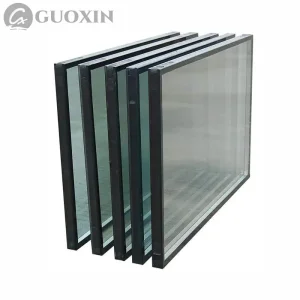
By positioning the frosted glass surface within an Insulating Glass Unit (IGU) (typically on surface #2 or #3), projects can combine aesthetic privacy with low-emissivity (Low-E) coatings and argon gas fills. This configuration minimizes heat transfer, helping projects achieve LEED certification and meet rigorous municipal energy codes.
For applications in high-wind regions, public balustrades, or overhead skylights, we laminate frosted glass panels using PVB or DuPont SGP interlayers. In the event of mechanical impact, the glass fragments adhere to the interlayer, minimizing injury risk and preserving the building envelope's integrity.
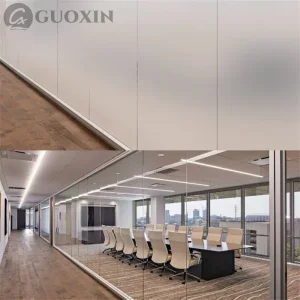
In high-density office environments and hotel partitions, custom frosted glass assemblies can be configured with acoustic PVB interlayers. This configuration yields a high Sound Transmission Class (STC) rating, preventing noise transfer between meeting spaces while diffusing natural light.
Exporting glass globally requires adherence to international testing regimes. Jiangsu Guoxin Glass maintains a rigorous quality assurance program where every production run is certified to meet regional standards:
Our safety glass lines comply with ANSI Z97.1 and SGCC (Safety Glazing Certification Council) standards, validating impact performance and fracture behavior for safety applications in the US and Canada.
We manufacture to EN 12150 (tempered safety glass standards) and EN 14449 (laminated safety glass standards). Our products carry the CE mark, verifying compliance with EU health, safety, and environmental protection legislation.
Our in-house laboratory conducts daily tests, including fragmentation testing, surface stress measurements, spectrophotometer validation for light transmission ratios, and extreme temperature thermal cycling to identify potential defects.
The glass industry is shifting from static privacy solutions to dynamic smart glass. At Guoxin Glass, we are scaling our engineering workflows to integrate these innovations:
PDLC technology allows glass to transition from transparent to frosted at the click of a switch. Applying an electrical charge aligns the liquid crystal molecules, allowing light to pass through. When the current is removed, the crystals revert to random orientations, scattering light and creating instant frosting. This technology is becoming a standard specification for high-end corporate boardrooms and hospital partition walls.
Traditional acid etching processes require complex environmental scrubbers and neutralizing compounds. We are investing in closed-loop chemical reclamation systems that recycle up to 90% of processing fluids, significantly reducing the environmental footprint of our glass and helping projects achieve green building certifications.
In today's integrated global supply network, collaborative engineering is the key to architectural success. Jiangsu Guoxin Glass Co., Ltd. is committed to working with designers, builders, and developers worldwide to deliver reliable, high-performance glass installations.
Whether you require standard privacy partitions, high-security laminated assemblies, or bespoke insulated glass units, our technical consulting team is available to assist you from project design to site delivery.
 Guoxin Glass